
Author: Hannes

  • Kensington Metropark: A quick birders guide through the winter

    Kensington Metropark: A quick birders guide through the winter

    Kensington Metropark through the seasons: Winter birding guide.

    Kensington Metropark Winter Quick Facts

    LocationKensington Metropark
    Entry Fee$10 daily fee, $40 year pass for residents of Livingston, Macomb, Oakland, Washtenaw, and Wayne county, $45 for everybody else
    Park Hours6 a.m. – 10 p.m
    Target BirdsWaterfowl, Gulls, Pileated Woodpecker, Sandhill Cranes, Wild Turkeys
    Best Time to VisitEarly mornings in the winter
    TerrainSeveral up to 2 mi gravel nature trail loops, 12 miles of hike-bike trails
    FacilitiesPlenty of parking, nature center with animal exhibition (opens 10 am), heated restrooms
    Bite recommendationWitch’s Hat

    Kensington Metropark is located north of I-96 between Novi and Brighton. With 4,481 acres, it is one of the bigger (if not the biggest) Metroparks. A lot of its surface area is covered by woodlands and the big Kent Lake. For me, Kensington has some additional significance: It was the first park I went to with my now-fiancée.

    To many people, Kensington in the winter means cross-country skiing, toboggan riding, or ice fishing. For me, it means hiking the nature trails, scoping the lake for waterfowl, and visiting Ranger, the resident Red-tailed Hawk, after warming up in the Nature Center.

    Ranger, the local Red-tailed Hawk at Kensingon Metropark in the Winter
    Ranger, the local Red-tailed Hawk at Kensingon Metropark in the Winter

    The Nature Trails

    The Nature Center usually is one of the stops during my visits. It is the trailhead for four different interconnected loops through the forest. The terrain is quite hilly, and in the winter, it is not cleared of snow. This is not a problem when the snow is fresh, but it can become one once the snow is compressed into an icy trail.

    Like every other place, Kensington is more calm in the winter. But what you will definitely find are hungry birds. The Metroparks were, until recently, encouraging hand-feeding the birds. This led to an unnaturally high population of Black-capped Chickadees, Tufted Titmice, and Mourning Doves. I, myself, am not free of guilt: I did feed them before, but I will follow the directions of the park in the future.

    Eastern Bluebird at Kensingon Metropark in the Winter
    Eastern Bluebird at Kensingon Metropark in the Winter

    The woods around the nature trails are the perfect place to find Eastern Bluebirds and Pileated Woodpeckers. On my first trip to Kensington a couple of years ago, I did in fact see my first-ever Pileated Woodpecker.

    More Wildlife encounters in Kensington!

    Beautiful Turkey at Kensingon Metropark in the Winter

    Another typical find on the nature trails are the Wild Turkeys. But be cautious! They do like to come close, especially when they see you feeding other birds.

    The other highlight are the Sandhill Cranes. While most of Michigan’s Sandhill Cranes migrate south through the eastern flyway in fall, at least a dozen will winter in the Metropark. They are used to being close to humans and therefore make a good photo subject.

    Scoping Kent Lake

    In normal winters, when Kent Lake is not always fully covered in ice, it offers a great opportunity to scope for waterfowl. Here are my favorite spots to check:

    • East Boat Launch: This is a very convenient spot. You can park very close to the water and you do not have to carry your scope that far.
    • The Bridge (North of “The Big Intersection”): From here you are more likely to spot dabbling duck species, since the water north and south of the bridge is more shallow. Unfortunately, you have to walk there!
    • Beaches & Boat Rental: Both of the beach parking lots, as well as the parking lot for the boat rental, are closed in the winter months. However, these places are still your best bet to see rare gulls, Kingfishers, or just to have another spot to scope. Even in the winter, you can reach those areas using the hike-bike trail.
    Heron Rookery waiting for first signs of Herons and spring
    Heron Rookery waiting for first signs of Great Blue Herons (They will start come back late February) and spring

    While I recommend to definitely wear some warm cloths and layer up, I recommend to leave the bird seeds at your feeder at home. To me, a typical winter trip to Kensington includes the following gear:

    My typical gear list

    • Thermal pants (for temperatures sub freezing)
    • Heavy gloves
    • Warm Hat (Detroit Lions Hat)
    • Warm Coat
    • Sony A7IV + Sigma 150-600mm F5/-6.3 DG DN
    • Camera Strap
    • Vortex Crossfire HD 10×42 Binoculars
    • Vortex Crossfire HD 20-60×80 Spotting Scope
    • Snacks (ideally homemade)

    Now what? Einkehren at the Witch’s hat brewery in South Lyon

    If you read through my other reports and guides, you know by now, that I do like a good beer every once in a while. And what is there better to do than grabbing a local craft beer after a long day in the cold.

    My recommendation for today is the Witch’s Hat Brewing in South Lyon. They are located 10 to 15 minutes south of Kensington (depending on where you are in the park). My last visit was before I decided to start this Blog, so you must forgive me, that I do not have a more extensive review. I will add that as soon as I was there the next time!

    If you liked this little guide, please also make sure to visit my reports and guides about Belle Isle, Lake St. Clair Metropark and on how-to not find Snowy Owls!

    Did I miss anything? Let me know in the comments below! And please make sure to subscribe to my mailing list for monthly updates outside of my blog! 🥨🦉

  • Finding the Best Döner Kebab in Detroit: A German Expat’s Quest

    Finding the Best Döner Kebab in Detroit: A German Expat’s Quest

    I really do enjoy most of the food available in US restaurants. I like burgers, I like Detroit-style deep dish pizza, and I even catch myself eating a Costco hot dog every once in a while. But even with the infinite choices of restaurants and convenient food, I still find myself missing Germany’s number one fast food: the Döner Kebab.

    What is a Döner, anyway?

    A Döner, in its most common form, consists of seasoned ground meat (with some binders and spices) grilled on a vertical rotisserie, thinly sliced, and tucked into a flatbread. Much like the experience at a Subway, you then choose your fresh toppings from little trays right in front of you. The first time this meal was recorded in its modern sandwich form was in 1972 in Berlin, when Kadir Nurman served the first Döner sandwich.

    Yufka Döner, Back in Germany
    Yufka Döner (Döner in a Flour Tortilla basically)

    Why is German Döner Kebab So Hard to Find in Michigan?

    “Einmal Döner mit allem, bitte!”—which means “One Döner with everything, please”—including the chili flakes. I miss saying those words. I also miss Döner Pizza, Yufka Döner, Lahmacun, and all the wonderful things Turkish immigrants brought to Germany—even to my little hometown, Weilheim an der Teck. Unfortunately for me, there aren’t many Turkish people living in Michigan, which makes it hard to even find a Döner!

    However, I didn’t find just one, or even two—I found three places in the Detroit area where you can find a Döner. Here is my breakdown of Cork & Gabel, Supergeil, and the Balkan House.

    1. Cork and Gabel: A Fancy Twist on a Street Food Classic

    This restaurant made the list by coincidence. Ali and I were planning to get a Döner at Supergeil, but they were undergoing renovations at the time. We decided to head to Cork & Gabel, which is located just across the street, in Detroit’s Corktown neighborhood.

    The entrance welcomes guests through a massive steel tank, and once inside, you are greeted by a rustic, industrial aesthetic with a large bar in the middle. It feels both fancy and cozy. While scanning the menu, we were surprised to see a Döner listed. Since we were already in town for exactly that, we placed our order.

    The "German Döner" at Cork and Gabel Detroit
    The “German Döner” at Cork and Gabel Detroit

    The Verdict: The Döner here is pulled lamb shank meat served on pita bread with fries. All in all, it’s a very good meal. But is it a good Döner? That depends! To me, a Döner is generally not something you’d eat in a “nice” restaurant, so the vibe already felt slightly off. The meal itself is probably ten times higher quality than your average German Döner, but it just wasn’t “it.” It reminded me more of a Pita Gyro. While the spices were good, they didn’t trigger my nostalgia.

    • Overall Experience: 5/5
    • Döner Authenticity: 3/5
    • Pro-Tip: They have a great selection of German beers—another pleasant surprise!

    corkandgabel.com – 2415 Michigan Ave, Detroit, MI 48216

    2. Supergeil: The Hip Berlin Vibe

    Only two weeks after our surprise Döner encounter, we finally made it to Supergeil. Located in Corktown, this restaurant leans into the “hip” Berlin aesthetic. Their menu is unique—neither strictly German, American, nor Turkish, but rather a fusion influenced by all three. The interior is a mixture of industrial design and art.

    Beef and Lamb Döner Sandwich at Supergeil in Detroit
    Beef and Lamb Döner Sandwich at Supergeil in Detroit

    The Verdict: Their Döner meat is a mixture of lamb and beef. It is served in a flatbread and comes in the typical square paper wrap. The taste is great and certainly triggers memories of Döner in Germany. The quality of the meat is excellent, and the “Scharf” (spicy sauce) has a real kick!

    However, the presentation isn’t quite at 100% yet—the meat was buried a bit too deep under all the “healthy stuff.” At $17, it is also the most expensive Döner on this list.

    • Döner Taste: 4/5
    • Döner Experience: 3.5/5 (The place feels a bit too “artisan cocktail bar” for a street food staple).
    • Overall Place: 5/5 Google Stars.

    supergeildetroit.com – 2442 Michigan Ave, Detroit, MI 48216

    3. The Balkan House: The Closest You’ll Get in Metro Detroit

    Last but not least is the Balkan House. Located in Ferndale’s vibrant downtown area, the Balkan House offers Balkan specialties and Döner Kebab. Unlike the other two, the focus here is strictly on the food rather than the “nice restaurant” ambiance.

    On a search for Döner in the Detroit Metro area, this place is usually the first result. It was for me, too, which is why it was the first Döner I ever tried in the US.

    Döner at the Balkanhouse in Ferndale, Michigan
    Döner at the Balkanhouse in Ferndale, Michigan

    The Verdict: The Balkan House business seems to be mostly carryout. I was sitting alone at a black table with expectations close to zero. Once the Döner arrived, I was relieved: it looked and smelled exactly like a German Döner. Even the taste hit the nail on the head.

    The only caveats are the preparation and the bread. I didn’t see a rotisserie grill, nor did I see the Subway-style bar with fresh ingredients and sauces. We could debate the bread choice, but since there are huge regional differences in bread even within Germany, I won’t be too nitpicky.

    • Döner Taste: 4.5/5
    • Döner Experience: 4.5/5 (Losing half a point only for the missing rotisserie).

    thebalkanhouse.com – 314 W Nine Mile Rd, Ferndale, MI 48220

    Summary: Which Michigan Doner should you visit?

    All three restaurants have their place and provide a great experience, but only one truly captures the essence of a German Döner joint: The Balkan House. They aren’t “perfect,” but they focus on the fast, convenient nature of the Döner rather than a fine-dining experience.

    I highly recommend trying them for yourself! Or, do what I do: go to Cork & Gabel for the beer, Supergeil for the cocktails, and get your Döner from the Balkan House.

    How did you like this little Essay about my quest of finding proper Doener in the Detroit Metro? Let me know in the comments, and make sure you’ll check the subscribe box. You can also find my opinion of German restaurants in the metro here. Every of my birding posts comes with some restaurant recommendation as well, so if you’re not here for the birds, just scroll down for the bites. 🥨🦉

  • Top German Appetizers you’ve probably never even heard of.

    Top German Appetizers you’ve probably never even heard of.

    This is a brief collection of German appetizers you may have never heard of. All of them are either available in my recipe index already or will be coming soon! I will update this collection as I add more, so make sure to subscribe to my mailing list so you don’t miss any!

    Four-Ingredient Pastry Snack Snails

    These were the very first recipe I posted on this page! They only require four ingredients: puff pastry dough, cream cheese, shredded cheese, and bacon. They are incredibly easy to make and even easier to overeat—so make sure you have someone to share them with!

    More finished snack snails.
    Finished snack snails.

    Käsefüße (Savory Cheese Cookies)

    In German, Käsefüße is what we call “smelly feet,” but Käse also means cheese. This is a bit of a play on words since these cookies traditionally come in the shape of a foot. They can best be described as a savory cheese biscuit; my friends actually compared them to the Red Lobster Cheddar Bay Biscuits! The dough is easy to prepare, and they are delicious both warm and cold. Try them at your next social gathering!

    Käsefüße - cheesy feet!
    Käsefüße – cheesy feet!

    Bätscher

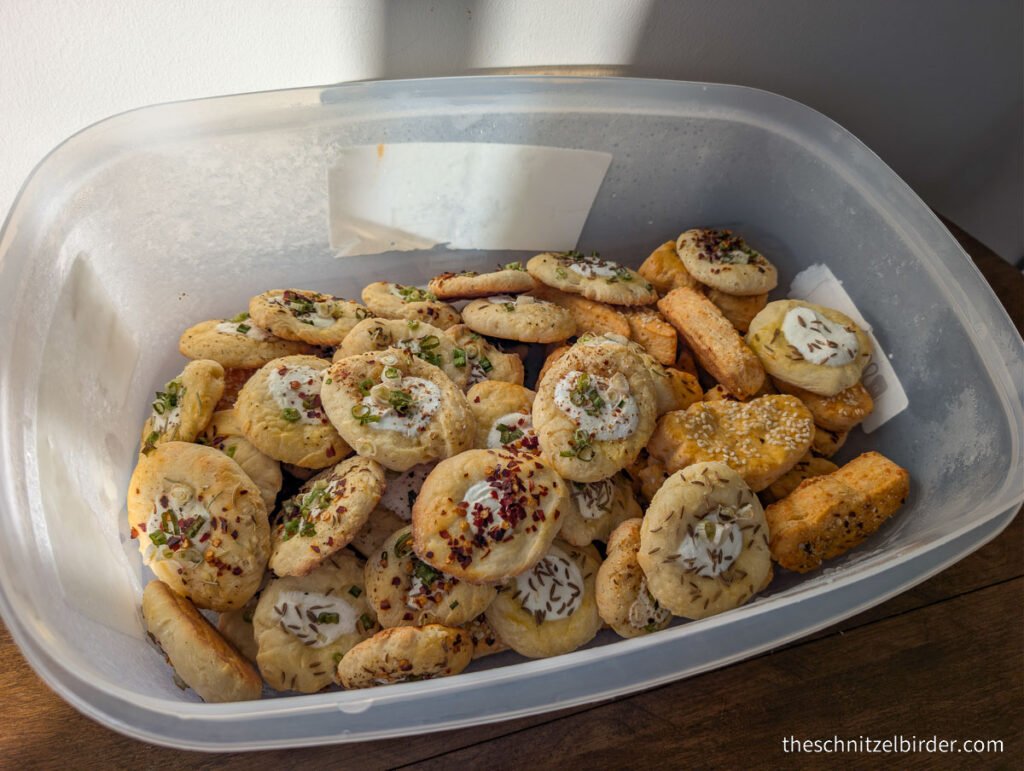
    Bätscher will likely be unknown even to most Germans, as they are a super-local snack from my Swabian home region. They are made with a yeast dough and topped with sour cream, chives, caraway seeds, bacon, or whatever else you like. When serving them as a starter, you can make them tiny for finger food, but they can also be made larger for a main meal. My sister thankfully provided me with a recipe that a friend of ours uses, and they are always a hit at buffets!

    Baetscher on a tray.
    Baetscher just before being baked.

    Birder’s Note: Many of these appetizers are sturdy enough to be packed in a container and brought along on a birding trip. There’s nothing better than a homemade Bätscher while waiting for a rare migrant to show up! 🥨🦉

  • Cheesy Savory Crackers (Käsefüße) – German Appetizer

    Cheesy Savory Crackers (Käsefüße) – German Appetizer

    These savory crackers (Käsefüße) are a staple at German parties. They are buttery, cheesy, and perfectly salty—the ultimate companion for a glass of wine or a cold beer while watching birds from the porch.

    The Legend of the “Käsefüße” Scroll

    Back in the day, when I was a little kid in Germany, there was a massive trend of gifting a specific cookie cutter in the shape of a foot. Attached to the cutter was always a little paper scroll tied with a ribbon. When you unrolled the scroll, you found the original recipe for “Käsefüße” (Cheese Feet).

    For quite some time, these were at every social gathering—everywhere! Us kids loved them, especially fresh out of the oven, when the cheese and other fatty components were still melted and gooey inside the crisp shell.

    Baetscher and Käsefüße (savory cheese cookies)
    Baetscher and Kaesefuesse (savory cheese cookies)

    I served the Käsefüße for my birthday celebration and people were comparing them with the Red Lobster Cheddar Bay Biscuits. I never had those, but they said they were great!

    Cheesy Savory Crackers (Käsefüße)

    Learn how to make this super easy cheesy German starter.
    Prep Time15 minutes
    Cook Time15 minutes
    Chilling time2 hours
    Total Time2 hours 30 minutes
    Course: Appetizer, Finger Food, Starter
    Cuisine: German, Swabian
    Keyword: appetizer, cheesy, german, german appetizer, starter, swabian
    Servings: 20 Cracker
    Calories: 150kcal

    Ingredients

    • 11 tbsp Unsalted Butter softened
    • 1 1/2 cups Shredded Cheese something with taste, like sharp cheddar or pepper jack
    • 2 cups All-Purpose Flour
    • ½ tsp Salt
    • ½ tsp Baking Powder
    • ¼ tsp Ground Black Pepper
    • 1 tsp Paprika Powder
    • 1 tsp Garlic Powder
    • ½ cup Heavy Cream

    For the Toppings

    • Egg wash (1 egg beaten with a splash of water or milk)
    • Seeds & Spices Caraway seeds, sesame seeds, or chili flakes

    Instructions

    • Prepare the Dough: In a large bowl, knead the softened butter with the shredded cheese, flour, salt, baking powder, pepper, paprika, and heavy cream until a smooth, cohesive dough forms.
      The Käsefüße Dough
    • The Chill: Cover the dough and place it in the refrigerator for at least 2 hours.
    • Roll and Cut: Preheat your oven to 400°F (200°C). On a lightly floured surface, roll out the dough to a thickness of about 1/4 inch (5 mm). Use your favorite cookie cutters to stamp out shapes. (They get their name from their typical shape: A foot!)
      Rolled out dough for Käsefüße
    • Decorate: Place the cutouts onto a baking sheet lined with parchment paper. Brush each cracker with the egg wash. Sprinkle generously with caraway, sesame, or chili flakes according to your taste.
      Decorating the Käsefüße
    • Bake: Bake for around 15 minutes until the crackers are golden brown and crisp. Let them cool slightly on the tray before moving them to a wire rack.
      Käsefüße and cheesy birds

    If you liked these, you should also try my pastry dough snack snails!

    How did you like my recipe? Let me know in the comments below! And don’t forget to subscribe to my mailing list! 🥨🦉

  • German Birthday Traditions in Michigan: Goulash, Birds, and 40 Years

    German Birthday Traditions in Michigan: Goulash, Birds, and 40 Years

    Reflections on Heritage, Red-winged Blackbirds, and the Secret to Authentic Goulash

    Celebrating a German birthday in Michigan is a mix of old traditions and new discoveries. From cooking a massive pot of authentic beef goulash to spotting my first Red-winged Blackbird, this 40th birthday marks a major milestone.

    When you read this, I will probably be in Kentucky to celebrate concluding forty years on this planet I call home. I will post a detailed report about that trip later, but for now, I want to look back.

    While forty years is a lot of life, the past four years have definitely been the most life-changing. I landed in Detroit in February 2022; the original plan was to be here as an expat for only two years. Now, in 2026, I am still here—and quite a few things have changed!

    Discovering Michigan Birding: The Red-winged Blackbird

    After walking “blind” through my first year in Michigan, being rather stunned by everything being so new, I discovered those black birds with the bright red wingtips. My curiosity took over, and I Googled what they were. I became a birder that very day! There is a reason my “About” page features a huge Red-winged Blackbird.

    Red-winged Blackbird at LSC Metropark
    Red-winged Blackbird at LSC Metropark

    Finding My “Person”

    The other life-changing event happened a bit later: I met my now-fiancé, Ali. Coincidentally, she also liked birds (not as obsessively as me, but close enough). We also discovered we have plenty of other things in common, like our taste in music, a shared wanderlust, and a mutual love for discovering new breweries and local food.

    German vs. American Goulash: A Cultural Kitchen Shift

    One of my favorite things to do for Ali is cook traditional German meals. Early on, I impressed her with my Goulash—but only after I learned what “American Goulash” actually was!

    A Quick Translation: In Germany, Rindergulasch is a slow-simmered, rich gravy made with tender cubes of beef and a massive amount of onions and paprika. In Michigan, I discovered that “Goulash” often means ground beef, macaroni, and tomato sauce. Both are delicious, but they are entirely different species of comfort food!

    After a few more cooking sessions, an engagement, and moving in together, I got the idea to start a recipe collection and share my birding stories. And here we are now: post number 20, published on my 40th birthday.

    My Traditional Swabian Birthday Menu (Recipes Included)

    Last Saturday, the 7th, I did something I really do not like: Celebrating my birthday before it actually was my birthday. But with my Kentucky trip and Ali working the weekend after, it made sense to pre-celebrate my birthday. Celebrating your birthday before the actual date is considered bad luck in Germany!

    Nonetheless, I invited some people over to our house to provide them with the finest German food:

    • Gulasch/Goulash: The German winter comfort food! I cooked a big pot of it the day before.
    • Spaetzle as a side dish. Making them fresh when the guests were already there was part of the entertainment!
    • Oreo Truffles: Ali made her famous Oreo Truffles. You must try them!
    • Kaesefuesse: A German appetizer best described as savory cheese cookie.
    • Baetscher: A adaptation of the Swabian Baetscher. Yeast dough, sour cream and some toppings like bacon, carraway and chives.

    All recipes you can either find already here, and they are linked, or I will update them later!

    The Not-birthday Birthday Celebration! Visiting the Haunted Tavern in Ann Arbor, Michigan

    Ali and I at the haunted Tavern

    Before we welcomed our guests, we went to the Haunted Tavern in Ann Arbor. This is a traveling event, where you can drink some selected cocktails and listen to spooky stories adapted to the area they are visiting at the time. It was a lot of fun, and you should definitely check them out, the next time they are around!

    The Celebration itself was calm, we had some drinks and everybody was enjoying the food. I wish I could have celebrated with all my friends and family from Germany as well! But we will make up for that soon in April and May when we will be visiting Germany for the next time!

    Now one last ask for my birthday: Please subscribe to my mailing list 🙂 🥨🦉

  • Goulash: The Beef Stew That Traveled the World

    Goulash: The Beef Stew That Traveled the World

    Goulash, or Gulasch in German, is a paprika-heavy beef stew (sometimes with venison or pork). It is my go-to meal when I have plenty of time to cook, it was the first “real” German meal I ever prepared for my fiancée, Ali, and it is my top choice whenever I need to provide food for a large group of people.

    A Childhood Love-Hate Relationship

    Goulash and I have a long history. When I was a young child, my mother or father would cook it using very fatty stew meat. It was always served with either spiral pasta, Spätzle, or rice—and never without apple sauce.

    I had a love hate-relationship with it. I didn’t particularly like the texture of the fatty beef, but on the occasions when my parents bought nice, lean meat, the meal was like a dream.

    The College Evolution my Goulash

    When I first started college and began cooking for myself, I tried to make Goulash on my own. It was okay, but it was never as good as I remembered it. Over the years, I tried again and again. Through that process, I learned better cooking techniques: I discovered that red wine is non-negotiable for my palate, and I learned that you can simply never have enough paprika in a good Goulash.

    The vegetables for the Goulash
    The vegetables for the Goulash

    Global Variations and Culture Shock

    Over time, I also learned that not all Goulash is created equal. For instance, I discovered that in Hungary, Goulash is actually a quite thin soup, often containing potato cubes and served only with bread. The meal I refer to as “Goulash” is actually called Pörkölt over there.

    However, my biggest culture shock came when I learned what “American Goulash” is. Macaroni with ground beef? That was quite a surprise! I haven’t tried it yet, but I bet it’s still delicious.

    Writing Down my Goulash “Non-Recipe”

    I never actually used a recipe to cook Goulash, so writing down “my” version for the first time and comparing it to the information available online was quite rewarding. It was interesting to see that my version has some unique characteristics, yet it doesn’t reinvent an already great meal.

    I hope you enjoy my recipe. For the summer, I am planning to make a version of Hungarian Goulash while camping, so stay tuned!

    Home-style German Goulash

    This recipe produces a rich, concentrated sauce. If you prefer a more "soupy" Gulasch, simply add a bit more broth or red wine during the simmer.
    Prep Time20 minutes
    Cook Time2 hours
    Total Time2 hours 20 minutes
    Course: Main Course
    Cuisine: German, Hungarian
    Keyword: german cuisine, goulash, home-style, Hungarian
    Servings: 4 servings
    Calories: 595kcal

    Ingredients

    • 1 to 1.5 lbs Stew beef cut into 1-inch cubes
    • 3 tbsp Clarified butter or vegetable oil for high-heat searing
    • 1 to 2 Medium yellow onions finely chopped
    • 1 Red bell pepper finely diced
    • 3 cloves Garlic minced
    • 1 cup Dry red wine for deglazing
    • 2 cups Beef broth
    • 2 tbsp Tomato paste
    • 3 tbsp Sweet Paprika powder use high quality for the best color!
    • 1 tsp Chili powder or red pepper flakes adjust to your heat preference
    • 1 to 2 Bay leaves
    • 1 tsp Freshly ground black pepper
    • 1 tsp Salt plus more to taste

    Instructions

    • The Sear: Heat the clarified butter in a Dutch oven or heavy pot over medium-high heat. Sear the beef in batches. Do not crowd the pan; you want a dark brown crust on the cubes, not grey steamed meat. Remove the meat and set aside.
      Searing the meat in badges for Goulash
    • The Aromatics: In a second bigger pot, add the finely chopped onions and sauté with olive oil until they are translucent. Add the garlic and tomato paste, stirring for 1 minute until fragrant.
      Saute the onions with garlic and tomatoe paste
    • Deglaze: Pour in the red wine. Use a wooden spoon to scrape the bottom of the pot to release the Fond. Let the wine reduce by about half.
      Deglazing the Pan with red wine
    • Build the Braise: Add the beef to the pot. Add the beef broth, diced red peppers, paprika, chili, black pepper, salt, and bay leaves.
      Seasoning the Goulash with paprika, salt, bay leaves, pepper
    • The Long Simmer: Bring to a boil, then reduce heat to low. Cover and simmer for 1.5 to 2 hours. You know it’s ready when the beef is fork-tender and the sauce has naturally thickened into a dark, rich gravy.
      Now the long simmer of the Goulash begins
    • The Final Check: Taste the sauce. This is when I usually add a bit more chili powder if I want more kick. Remove the bay leaves.
    • Serve: Ladle the Gulasch over your favorite side—Spätzle, bread dumplings (Knödel), or even rice. Top with a spoonful of cold sour cream and serve the apple sauce on the side.

    Notes

    The 2 hours of cooking time is a absolute minimum! I recommend rather 3+ hours.

    If you liked my Goulash Recipe, you should also try my Sauerbraten!

    My Side recommendations are Spätzle, Knödel, Pasta, Mashed Potatoes.

    More Swabian Comfort Food: SchnitzelSauerbratenKaesefuesseKartoffelsalat

    Decorating the Käsefüße
  • Ali’s Oreo Truffles: A Story of Successful Failure

    Ali’s Oreo Truffles: A Story of Successful Failure

    My fiancée, Ali, takes a lot of pride in this recipe. It is a very simple variant of strawberry Oreo truffles, and it has its own little story of “successful failure.”

    The “Crazy Aunt” Inspiration

    Ali originally got a recipe for strawberry Oreo truffles from her “crazy aunt,”. The first attempt to recreate them failed miserably—it was a total mess with the fresh strawberries and the whipped cream. Her next attempt was only slightly better after she decided to leave out the whipped cream.

    Finally, on the third attempt, she said, “f* it, I’m just replacing the wet strawberries with chocolate chips,” and the result was amazing!

    From Failure to Favorite

    Only later did she find out that many recipes call for freeze-dried strawberries instead of fresh or frozen ones. But without that little failure, the Oreo truffles as they are today would not exist.

    Today, these truffles are her go-to dish to bring to social gatherings and a consistent favorite on our Friendsgiving nights. Best of all, they only require four simple ingredients:

    • Vanilla Oreos (or any other Oreos, but Vanilla are just the best for us!)
    • A brick of cream cheese!
    • Chocolate Chips
    • Vanilla Coating
    All you need for Vanilla Oreo Truffles
    All you need for Vanilla Oreo Truffles

    We hope you enjoy this easy recipe!

    The finished OREO truffle with the optional chocolate decor
    Print Recipe
    5 from 1 vote

    Vanilla Oreo Truffles

    A simple, crowd-pleasing dessert made from crushed Vanilla Oreos and cream cheese, studded with chocolate chips and dipped in a sweet vanilla coating. Born from a kitchen mishap, these truffles are now a family staple.
    Prep Time25 minutes
    Freeze time1 hour
    Total Time1 hour 25 minutes
    Course: Appetizer, Dessert, Snack
    Cuisine: American
    Keyword: dessert, oreo truffles, oreos, snack
    Servings: 45 Truffles
    Calories: 160kcal

    Ingredients

    • 1 family-size package Golden Oreos
    • ½ bag mini semi-sweet chocolate chips 6oz
    • 1 block 8 oz cream cheese
    • 2 bags white vanilla melting wafers Ghirardelli recommended, but other brands work as well

    Instructions

    • Crush the Oreos: You can use a blender, or smash them in a zip-top bag with a rolling pin.
      Crushing the Oreos with a rolling pin
    • Add the cream cheese: Mix until the mixture reaches a cookie dough–like consistency.
      Adding the cream cheese to the crushed oreos
    • Add the chocolate chips: Add about half a bag of mini chocolate chips (or more, to taste).
      Adding the chocolate chips to the dough
    • Form and freeze: Roll the mixture into balls. Freeze for at least 1 hour.
      Forming the dough in little balls
    • Coat with white chocolate: Prepare the vanilla melting wafers according to the package directions. Dip the truffle balls in the melted white chocolate and place them on parchment paper to harden. You will probably not need both packs of coating entirely.
      Coating with the vanilla candy coating
    • Optional decorations: Melt additional chocolate chips and drizzle over the truffles, if desired. Sprinkles are also an option, but they must be added before the white chocolate hardens.
    • Chill and serve: Refrigerate until ready to serve.
      The finished OREO truffle with the optional chocolate decor

    If you are interested in more Ali’s American Family Classics, you should try her recipe for Spinach Artichoke Dip.

    When you are interested in what else a German guy is doing in Michigan, you can check out my birding guides and reports like the summer trip to the Pointe Mouillee SGA.

    Let me know what you think in the comments below! 🥨🦉
  • Beyond Sauerkraut: The Swabian Sauerbraten

    Beyond Sauerkraut: The Swabian Sauerbraten

    It surprises a lot of people that German cuisine has a lot of weird-sounding sour meals other than the obvious Sauerkraut. Everybody knows of Schnitzel and Potato Salad, but what about Saure Nieren (Sour Kidneys), Saure Kutteln (Sour Tripe), or the more common Sauerbraten (Sour Roast)? The latter is the star of today’s post.

    The Great Sauerbraten Divide

    First, if a German talks about Sauerbraten, they could mean two different things: the “Rheinische Sauerbraten” (Rhineland style) and the “Schwäbische Sauerbraten” (Swabian style)—and all the other local variations. Since I am very much focused on my home area, Swabia, this is the Sauerbraten we will talk about here. It is more actually sour than the Rhine version, which is commonly served with a sweeter gravy.

    An Adult’s Appreciation for the Sour

    I wish I could say that Sauerbraten was a childhood favorite. When my mother was making it, my brother and I were not really amazed. Sour meals were tough to sell to us. Just like I developed a taste for bitterness as an adult, I also developed a taste for sour things, which goes beyond sweet-and-sour Haribo gummies.

    Trying the cooking wine on a cold day in Winter 2026

    The Challenge of the American Kitchen

    The Swabian Sauerbraten gets its taste through brining the beef roast for at least three days in red wine vinegar, red wine, and a mixture of vegetables and spices. The challenge in the US is finding all those spices. In this recipe, I will use some replacement products. The following items from the original recipe got replaced:

    • Juniper Berries: Instead of juniper berries, you can use a mix of caraway seeds and rosemary. If even caraway seeds are hard to obtain, try coriander seeds!
    • Mirepoix: Obviously, you can get all the mirepoix vegetables in the US, but unlike in Germany, you cannot buy a nice pack of carrots, celery root, leeks, and parsley. You have to buy those separately. My replacement here is that I replaced the leeks with nothing and used the celery stalks instead of the roots.
    • Mustard Seeds: You can replace the tablespoon of seeds with a teaspoon full of ground mustard.

    My recipe considers the first two ingredient replacements already. You can of course use celery root, juniper berries, and leeks, if those are available to you! 🥨🦉

    What can I do while the Sauerbraten is doing its thing?

    I am not just a recipe blog. I also like to write about my other hobbies which are birding and exploring the world. In the meantime you could read about my last trip to PTE Mouilee or how I was not successful on my hunt for snowy owls.

    Swabian Sauerbraten

    Swabian Sauerbraten adapted for the American kitchen, swapping tricky-to-find juniper berries for a rosemary/caraway blend and using a coffee filter "spice bomb" for a clean, deep flavor.
    Prep Time35 minutes
    Cook Time3 hours
    Resting Time3 days
    Course: Main Course
    Cuisine: German, Swabian
    Keyword: beef roast, german, sauerbraten, sour roast, swabian
    Servings: 8 servings
    Calories: 842kcal

    Ingredients

    For the Marinade (Beize)

    • 1 tbsp Mustard Seeds
    • 2 Bay Leaves
    • 1 tsp Black Peppercorns
    • 1/2 tsp Rosemary & 1/2 tsp Caraway Seeds Swap for Juniper berries
    • 1 3/4 cups Water approx. 400 ml
    • 7 oz Carrots, chopped 200g
    • 7 oz Celery, chopped 200g
    • 1 bunch Fresh Parsley
    • 1 Medium Onion
    • 3-4 Cloves of Garlic
    • 13.5 fl oz Red Wine Vinegar approx. 400 ml
    • 13.5 fl oz Dry Red Wine approx. 400 ml

    For the Roast (Braten)

    • 4.4 lbs Beef Chuck or Shoulder Roast approx. 2 kg Rinderbraten
    • Salt
    • 2 tbsp Sunflower Oil or Neutral Oil
    • 2 tbsp Tomato Paste
    • 1 tsp Sugar
    • 3/4 cup Dry Red Wine
    • 1 3/4 cups Beef Broth
    • 1 3/4 cups Water
    • 3.5 fl oz Heavy Cream

    Instructions

    • Toast the Spices: In a large pot over medium heat, toast the mustard seeds, bay leaves, black peppercorns, rosemary, and caraway seeds for 1–2 minutes. Stir constantly until the aromas are released.
    • Create the "Spice Bomb": Let the toasted spices cool for a moment. Place them in the center of a paper coffee filter. Gather the edges and tie it tightly with kitchen string (or unflavored dental floss) to keep the seeds from escaping into the brine.
    • Prep the Vegetables: Peel the carrots and celery, then cut them into 1-inch (2 cm) cubes. Dice the onion and wash the parsley. Peel your 3–4 garlic cloves and crush them slightly with the flat side of your knife to release the essential oils.
      Prepping the vegetables
    • Boil the Brine: Add the water and your "spice bomb" to the large pot. Bring to a boil. Once boiling, add the cubed vegetables, onions, garlic, red wine vinegar, and red wine.
      Boiling the Brine
    • The "Hannes" Cooling Rule: Remove the pot from the heat and let the brine cool down completely. This is a non-negotiable step; never add hot brine to raw meat, as it will "cook" the outside and seal the pores, preventing the marinade from penetrating properly.
    • The Long Soak (3–7 Days):  Place the beef chuck roast in a glass or ceramic container. Pour the cooled brine—including the vegetables and spice bag—over the meat.
      Pro-Tip: If the meat isn't fully covered, add a mixture of water and red wine vinegar (using a 3:1 ratio).
      Ready to wait for a few days
    • Storage: Cover and refrigerate for at least 3 days. Up to 7 days is even better for maximum tenderness.
    • Prep for Searing: When you are ready to cook, remove the meat from the fridge. Take the roast out of the liquid and pat it dry thoroughly with paper towels (this ensures a good crust). Discard the spice bag and strain the vegetables through a sieve, but be sure to save the liquid!
      Prepping for searing
    • Brown the Meat: Preheat your oven to 325°F (170°C). Season the meat with salt. In a Dutch oven or heavy roasting pan, heat the sunflower oil over medium-high heat. Brown the meat on all sides for 2–3 minutes until it has a dark, crispy crust, then set it aside.
      Browning the meat
    • Sauté the Aromatics: In the same pan, sauté the strained vegetables in the remaining fat for 2–3 minutes. Add the tomato paste and sugar. Stir for 1 minute until the paste smells toasted and slightly sweet.
      Sauteeing the veggies
    • Deglaze and Build the Sauce: Pour in the dry red wine. Use a wooden spoon to scrape up all the brown bits (the Fond) from the bottom of the pan. Let the wine reduce by half, then add the beef broth and 2.5 cups (600 ml) of your saved marinade liquid.
    • The Braise: Place the meat back into the pan and bring the liquid to a boil on the stove. Once boiling, cover the pan and move it to the lowest rack of the oven. Braise for 2.5–3 hours, turning the meat every 45 minutes to keep it moist.
      Putting the meat back into the pan
    • Reduce the Sauce: Once the meat is fork-tender, remove it from the pan and set it aside to rest. Strain the sauce or scoop out the vegetables. Simmer the liquid on the stove for 5–10 minutes to reduce it to a concentrated, rich gravy.
    • The Creamy Finish: Stir in the heavy cream. If you prefer a thicker sauce, you can puree some of the cooked vegetables and stir them back in. Season with salt to taste.

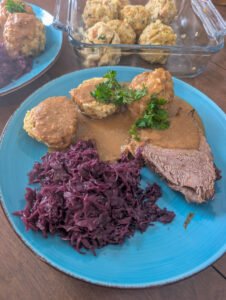
    Serve with your choice of sides. I recommend red cabbage, bread dumplings or spaetzle.

    Hengstenberg Red Cabbage With Apple

    Did you try my recipe? Let me know how it went in the comments below!

    If you are looking to eat a Sauerbraten in a local Detroit restaurant, check out the Dakota Inn! I have written a little article about them and some other German restaurants in the Detroit metro. 🥨🦉

  • The Art of the Dumpling: Semmelknoedel

    The Art of the Dumpling: Semmelknoedel

    A Semmelknoedel (bread dumpling) is a simple side commonly served with all kinds of roasts, Goulash, or as the star of the show just served with mushroom gravy. They are easily done, and can be sustainable when old bread is used instead of being thrown away.

    What bread should I use?

    Simple answer: Any bread works, but not all are equal. To get the texture right, the bread should be stale. Here in the US I prefer French or Italian bread. If you can get your hands on Kaiser Rolls, those will work best. In Germany I would just buy the already perfectly diced Knödelbrot in store.

    Can I use a stuffing mix for Semmelknoedel?

    Again, simple answer: Yes, you can. When I was eating stuffing at a Thanksgiving dinner, bread dumplings was exactly what it reminded me off. Which is why I had to test it! If you are using the already heavily seasoned stuffing, leave out the spices/parsley and only add the onions.

    Knödelbrot for Semmelknoedel
    Knödelbrot in the Storeshelf

    What should I do, when my dumplings fall apart in the water?

    First, your water should only simmer, and not boil like crazy. Second, before throwing all your dumplings in the boiling water, try with only one. If that dumpling is falling apart you can add breadcrumbs to adjust the texture. If they are to solid, you can add more milk into your dough.

    What goes well with Semmelknoedel?

    Semmelknoedel go well with all kinds of roasts, like Sauerbraten, Goulash, and with mushroom gravy!

    What do I do with my leftovers?

    Keep them in a container in your fridge. The next day, you can just take them out and either serve them as the day before, or cut little slices and fry them in some butter.

    Now, all you need to do is try it yourself! No worries if your dumplings are not perfect at first. They will still be great!

    Semmelknoedel (bread dumpling)

    Super easy and yummy German side dish made out of bread, eggs, onions and other spices!
    Prep Time20 minutes
    Cook Time20 minutes
    Resting Time30 minutes
    Course: Side Dish
    Cuisine: German, Swabian
    Keyword: bavarian, bread dumpling, german, semmelknoedel, side dish, swabian
    Servings: 8 dumplings
    Calories: 210kcal

    Ingredients

    • 6-8 Stale white bread rolls Kaiser rolls are best or about 300g of dry bread cubes.
    • 1 cup Whole milk warm
    • 3 Large eggs
    • 1 Small onion very finely diced
    • 2 tbsp Butter
    • ½ cup Fresh parsley finely chopped
    • ½ tsp Nutmeg
    • Salt and Black Pepper to taste
    • Optional: 2-3 tbsp of breadcrumbs if the dough is too wet.

    Instructions

    • Prepare the Bread: Cut your stale bread into small cubes (about 1cm). Place them in a large bowl.
    • Soak: Pour the warm milk over the bread cubes. Cover the bowl and let it sit for at least 20 minutes. The bread should soak up all the liquid but not become a total mush.
    • Sauté: In a small pan, melt the butter and sauté the onions and parsley until the onions are translucent. Let it cool slightly, then add it to the bread.
      Sauteeing the onions and parsley
    • Mix: Add the eggs, nutmeg, salt, and pepper to the bread. Use your hands to mix it gently. You want a cohesive dough, but you still want to see some structure of the bread cubes. If it feels too sticky, add a spoon of breadcrumbs.
      Mixing it all together
    • The Rest: Let the dough rest for another 10-15 minutes. This is crucial for the stability of the dumpling!
      Two different doughs: with old bread and with stuffing mix
    • Shape: With wet hands (this prevents sticking), roll the dough into balls about the size of a tennis ball. Make sure the surface is smooth with no deep cracks.
    • Simmer: Bring a large pot of salted water to a boil, then turn it down to a very low simmer. The water should not be bubbling hard!
    • The Float: Drop the dumplings in. They will sink at first. Let them simmer (not boil!) for about 20 minutes. Once they float to the top and stay there, they are done.
      Floating Dumplings!

    Did you try my recipe? Let me know in the comments below!

    On the search for some appetizers you can serve your dinner party before serving your Knödel with Goulash? I got the right collection here for you!

  • The Final Piece of the Puzzle: Creamy Jägersauce (Mushroom Gravy)

    The Final Piece of the Puzzle: Creamy Jägersauce (Mushroom Gravy)

    A Childhood Discovery: “Nature” Steak vs. Breaded

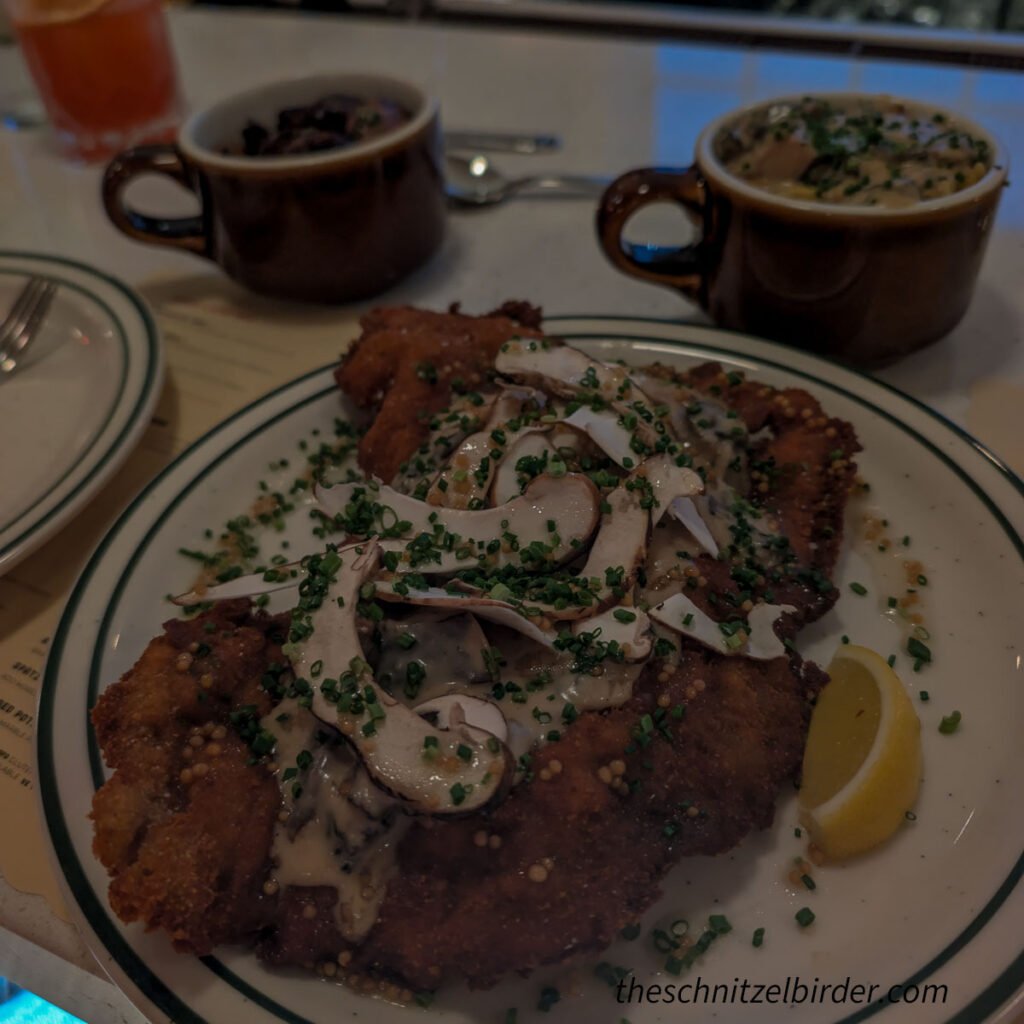
    When growing older, the Jägerschnitzel, usually with Spätzle, replaced the Schnitzel with fries as my favorite Schnitzel dish. The first time I ordered one as a child, I was a bit in shock: It is just a nature steak! My expectation was a breaded schnitzel with a mushroom gravy and not whatever that was. Once I overcame this initial shock, and I tried it, I learned the value of this pork steak like nature intended it. I would still most of the time pick the breaded variant, but the nature steak has its reason to exist.

    The Jägerschnitzel Trinity

    The creamy mushroom gravy I will show you in this little recipe post is the final missing ingredient to the whole Jaegerschnitzel Trinity: Schnitzel, Spätzle and Mushroom gravy. It makes one of the most perfect meals whole. It’s the last missing piece to a 1000 piece puzzle. It’s the yin to the Schnitzels yang. I am drifting away, but my opinion about this meal should be clear!

    Jägerschnitzel
    Jaegerschnitzel Trinity!

    Versatility in the Kitchen

    Yes, you can also use that sauce for everything else. Two other famous more vegetarian meals which go great with it are the Semmelknoedel (dumpling) and Kartoffelroesti (potato pancakes).

    The Secret: The Two-Pan Method

    When making this gravy I like to work with two pans. In one pan I am sautéing onions, garlic and mushrooms, while in the other pan I am making a roux. In Germany the more elegant solution was to use store bought roux for thickening. I am yet to find a good alternative for that. If you know of any, please leave a comment!

    If you are making a nature steak, you should deglaze your meat-frying pan with a splash of broth and add that flavorful liquid into your gravy! We do not want to let any of that good taste go to waste!

    Jägersauce – mushroom gravy

    Finish the Swabian Trinity! Learn the "two-pan" method for a creamy, authentic Jägersauce with mushroom and cream. Perfect for Schnitzel, Spätzle, or potato pancakes. 🥨🦉

    Prep Time15 minutes
    Cook Time20 minutes
    Course: Main Course, Side Dish
    Cuisine: German, Swabian
    Keyword: german, Gravy, Hunters Sauce, Mushrooms, Sauce, swabian
    Servings: 4 servings
    Calories: 220kcal
    Author: Hannes

    Ingredients

    • 1 lb Fresh mushrooms (Cremini or Baby Bella work best), sliced
    • 1 Medium yellow onion finely diced
    • 2 cloves Garlic minced
    • 4 tbsp Butter
    • 3 tbsp All-purpose flour
    • 2 cups Beef or vegetable broth
    • ½ cup Heavy cream or Half & Half
    • ½ cup Parsley chopped
    • Salt and Pepper to taste

    Instructions

    • Sauté (Pan 1): Melt 1 tbsp of the butter in a large pan over medium-high heat. Add the mushrooms and sauté until they have released their moisture and turned golden brown. Add the onions and garlic and cook until translucent.
      Sauteeing the mushrooms with garlic and onions!
    • The Roux (Pan 2): In a separate small saucepan, melt the remaining 3 tbsp of butter. Whisk in the flour and cook for 1-2 minutes until it smells slightly nutty but hasn't turned dark brown.
      Making a roux!
    • The Merge: Slowly whisk the broth into your roux to create a smooth, thick base.
    • Combine: Pour the thickened sauce into the mushroom pan.
    • The Secret Flavor: If you are making "nature" steaks, use a little extra broth to deglaze your meat pan and pour those delicious brown bits (the Fond) directly into the gravy.
    • Cream & Season: Stir in the heavy cream and parsley. Let it simmer for 5 minutes until the flavors meld. Season generously with salt and pepper.
      Finished Jaegersauce

    Serving Suggestion: Pour this generously over your Spätzle and your Schnitzel to complete the Trinity!

    Don’t forget to check out my recipe for bread dumplings!

    Tried my recipe? If so, let me know what you think and leave a comment!🥨🦉